Dear
Mr Whedon:
At
about the 11:30 mark in the film, Avengers, for
which you are credited as director, screenplay writer and co-author,
there begins a scene serving to introduce Natasha Romanoff, aka the
Black Widow, played by Scarlett Johansson. The scene begins with a
diesel train pulling into a rural train-station in Russia by night,
then pans left to a ruined warehouse, where we find a scantily-clad
Scarlett Johansson in distress, being tied to a chair and
interrogated rather brutally in Russian by someone in a 3-star
Russian general’s uniform. Then at about the 12:08 mark in the
film, the camera cuts to a long shot where the interrogation
continues in a mirror centered in the midst of a still life, thus:

We
can see that the still life, which might be entitled ‘Still Life
with Kalashnikov’, is a tastefully done still life with a 19th-Century type mirror artistically draped with an off-white fabric.
Chicly arranged to
the left of the mirror are two icons and on the right behind the two
AK-47 assault-rifle barrels a picture that we couldn’t identify but
which reminds us of the 16th-Century
Dutch Masters (echo of Scarlett’s role as the
girl with the pearl earring?).
We
were rather curious about this composition. First of all, let us
note that it adds nothing to the Avengers
story-line.
There is no further reference to icons—or indeed to Russia—in
the Avengers.
The only thing the scene can do is introduce Natasha, formerly
Russian KGB agent and now agent of SHIELD. Nowhere
further on in the film do we see Natasha’s dedication to icons or
iconography, or even Natasha’s Russianness, since only in this
scene does she speak Russian. So the question arises why the shot
was included in the film. A case could be made that it is
gratuitous. Moreover, the camera pulls back from the Still
Life with Kalashnikov while at the same time keeping in focus the long shot in the mirror of Natasha being interrogated, so it’s a rather
complex shot—unless of course it’s a digitally composited montage
with the Natasha scene photographed separately and then digitally
inserted into the space of the mirror. If the latter is the case, then the question
arises even more strongly why the scene was included in the film:
someone went to a lot of trouble to include Still Life with
Kalashnikov in the film.
Let
us look at the content of the Still Life with Kalashnikov.
First
let us look at the icons. The main icon portrayed is a copy of this
icon:

We
say ‘copy’ because the original of ‘Our Lady of Perpetual Help’
is as follows:
Our
Lady of Perpetual Help,
also known as Our
Lady of Perpetual Succour, is
a title given to the Blessed Virgin Mary by Pope Pius IX, associated
with a celebrated Byzantine icon of the same name dating from the
15th century.
The icon has been in Rome since 1499, and
is currently in the church of Sant'Alfonso di Liguori all'Esquilino.
In the Eastern Orthodox Church this iconography is known as the
Virgin of the Passion or Theotokos of the Passion.
Due to the Redemptorist Priests who had
been appointed as missionaries of this icon, the image has become
very popular among Roman Catholics in particular, and has been very
much copied and reproduced. Modern reproductions are sometimes
displayed in homes, business establishments, and public
transportation. The Redemptorist priests are the only religious order
currently entrusted by the Holy See to protect and propagate a Marian
religious work of art.
The icon has merited two Papal
endorsements, one from Pope Pius IX who entrusted the icon to the
Redemptorist in December 1865, and another from Blessed Pope John
Paul II, who presented an icon to a Muslim cleric in May 2001 during
his first-ever visit to the Umayyad Mosque.
A feast in honour of the icon was
celebrated on 27 June and “novena” prayers are customarily held
on Wednesdays. Today, the feast day of the Our Lady of Perpetual Help
is celebrated on June 27 of the year, with novenas held every
Wednesday of the weeks of the year.
(From Wikipedia,
which is probably where we got the image of the icon. For a more
strictly Roman Catholic discussion see the Catholic
Encyclopedia)
So
the icon has nothing to do with Russia. (Pope John-Paul II was
Polish and Russians and Poles are almost the same, we know, but still
it’s not a Russian icon.) Moreover, unless someone was going to
steal the icon from its heavily guarded place in Rome, it’s not
something that a Russian arms smuggler would have in his dilapidated
warehouse in the Russian boondocks.
The
icon above and behind Our Lady of Perpetual Help (still to the left
of the mirror) is more difficult to identify. We at first thought
the icon might be of St Nicholas, the patron saint of Russia
(although we doubt he is the patron saint of Russian arms dealers),
but study indicates the following. The icon is of a full-bearded
male saint holding a very large Gospel book. The saint is depicted
in roughly ¾ profile from his left side. The framing of the icon—a
sort of clover leaf inside a square—reminds us of the icons of the
Evangelists that are normally found on the Royal Doors of the
iconostasis in every Orthodox Church, as do the small sub-icon above
and to the right of the saint’s head—it could very well be the
scriptural symbol of the Evangelist—and
the ¾ profile.
The
Royal Doors are the main entrance to the sanctuary; they are in front
of the Holy Table (what Westerners would call the altar, though in
the Orthodox Church the whole area behind the iconostasis is called
the altar).
Normally
the Royal Doors has two iconographical programs: the Annunciation of
the Birth of Christ to the Mother of God by the Archangel Gabriel
and, separately, the Four Evangelists. We were not able to find the
particular icon portrayed in the Avengers
and
hence the Royal Doors from which it might have been taken, but the
following should give an idea of what’s involved:

Above
we see the Annunciation and below we see the Four Evangelists. St
John the Evangelist is in the lower right corner; we can see that the portrayal of
St John here
is consistent, mutatis
mutandis,
with the icon in the Avengers,
although here the iconography is undistinguished. The icongraphical portrayal of
an Evangelist is fixed and it is relatively easy to identify an Evangelist if he is portrayed according to classical prototypes even if the name of the Evangelist on the icon is unclear.
Here
is a set of Royal Doors which while missing the Annunciation shows
clearly where the Royal Doors are in an Orthodox church: the Holy
Table can be discerned behind the Royal Doors. In this case St John
the Evangelist is in the upper right corner.

Here
is a clearer icon of St John the Evangelist, the composition of which
might parallel the icon in the Avengers
under
discussion:

Our judgement is that most likely the icon above Our Lady of
Perpetual Help in Still Life with Kalashnikov is taken from a
19th-Century
Royal Doors, perhaps of Russian origin. Moreover we are of the
opinion that the Evangelist portrayed is St John. Chances are that the icon was borrowed from a gallery for the shoot.

However,
here is the Royal Doors from the Cathedral of Christ the Saviour in
Moscow during the 2013 Christmas Divine Liturgy. We can see the
Annunciation above and the Four Evangelists in two groups of two
below. The 19th-Century iconographical program here is more Renaissance than in the icon under discussion, which would
suggest that the icon of the Evangelist from Still Life with Kalashnikov dates from an
earlier period.
Presumably
the evil-doers who are interrogating Natasha do one of the following:
- They pray before the Roman Catholic icon of Our Lady of Perpetual Help when they’re not torturing the scantily-clad Scarlett Johansson;
- They smuggle icons when they’re not smuggling Kalashnikovs;
- They smuggle icons at the same time they’re smuggling Kalashnikovs (‘Get your free authentic
Russian OrthodoxRoman Catholic icon with any black market purchase of 1000 Kalashnikov rifles, offer valid while supply lasts’). Today, however, the usual black market for the Kalashnikov is the Muslim jihadi and Muslim jihadis would not be interested in icons. However, perhaps the smugglers are imitating Pope John-Paul II, above; - Their business model includes a church supply business; or
- All of the above.
We
couldn’t come up with anything on the picture to the right of the
mirror, although it did remind us of the Dutch Masters, as we have
said. Vermeer comes to mind although the picture does not appear in
his catalog. The Lacemaker
is similar in composition but it is not the same.
We are sure you will agree, Mr Whedon, that it would only be right to give those of our pious Orthodox readers who feel that they have a religious vocation that includes arms smuggling a brief summary of the range of Kalashnikov assault rifles available on the market for smuggling.

Of course, one can see that the Kalashnikov included in the Still Life with Kalashnikov is the classic AK-47:

We are sure you will agree, Mr Whedon, that it would only be right to give those of our pious Orthodox readers who feel that they have a religious vocation that includes arms smuggling a brief summary of the range of Kalashnikov assault rifles available on the market for smuggling.
Of course, one can see that the Kalashnikov included in the Still Life with Kalashnikov is the classic AK-47:
We
should point out that as the camera pulls back from Still Life with
Kalashnikov, there are a number of what look like RPG rounds below
the icon of Our Lady of Perpetual Help (not shown).
Moreover,
it should also be pointed out that in terms of the rest of the scene,
the phone-call to Natasha is incoherent: the speaker warns the
General of an imminent F-22 attack on the place but describes the
place completely differently from what we see and as being in a
completely different location.
So
the question arises, Mr Whedon, what it’s all about. What’s this
stuff doing in the Avengers?
Now
let us continue with the iconographical program of the Avengers.
We’ve
just dealt with the evil ones of the Avengers.
Now
here’s a superhero from the Avengers,
Iron
Man without his iron as portrayed by Robert Downey:

To
be a little clearer about Iron Man’s casual-wear sartorial program,
here’s his t-shirt in more detail:

As
we can see it’s a t-shirt for Black Sabbath, the occultist rock
group. So we have a strong contrast: in the Avengers
the evil ones are gratuitously juxtaposed with Christian icons but
the superhero is gratuitously identified with an occultist rock
group. Hmm....
While
we would be surprised to learn that you have an overt hostility to
Russian Orthodoxy, Mr Whedon, you know as well as we do that this is
how propaganda works. Sophisticated information operations juxtapose
images that the perpetrators want the viewer to associate with evil
with obviously evil persons, and they juxtapose images that they want
the viewer to associate with good with obviously good persons. Here
we see Christian icons gratuitously juxtaposed with obviously evil
men; and an occult icon (Black Sabbath) gratuitously associated with
obviously good men. The effect is, as they say, long-term and
subliminal.
Let
us look a little more at the context of this.
Here’s
the casual-wear sartorial program of the evil Russian General:

There’s
a flash on his left arm that shows the Russian flag and which reads
‘Russia’ in Cyrillic:

You
can also see his three stars, so he’s a 3-star evil Russian
General. The only
thing missing in the Avengers
portrayal
of the 3-star evil Russian General is the open bottle of vodka. Must
be your light directorial hand, Mr Whedon.
However, we can see this in the uniform of a genuine 3-star Russian General:
However, we can see this in the uniform of a genuine 3-star Russian General:

No
Russian flag on the flash on his left arm. And this guy’s the real
deal. He’s
Russian
Deputy Chief of General
Staff Col-Gen Anatoly Nogovitsyn. Far more clean cut guy.
Here
Nogovitsyn’s boss, 4-star General Makarov, Russian Chief of General
Staff:

Scary
looking guy. Wouldn’t want to shoot a nuclear missile at his town.
Here’s
an American 4-star General, General George C Marshall:

Wouldn’t
want to shoot a nuclear missile at him either.
Here’s the guy who invented the Kalashnikov. He’s being presented with a medal by then-President Medvedev. His name, strangely, is Kalashnikov. He’s 90 years old. He’s only a 2-star general.

So
why are we wasting our time on this, Mr Whedon? Here in its
entirety is a recent article from the Independent,
a
London newspaper. We
would ask you to read the article through to its conclusion
despite the unseemly subject matter.
Get thee to a monastery... there's a brothel there
Roland Oliphant
Wednesday, 31 October 2012
The Russian Orthodox Church is furiously trying to calm a media storm after police uncovered a brothel on the grounds of one of Moscow's most prestigious monasteries.
The "hotel for lovers"
was found operating out of a building belonging to the Sretensky
Monastery, an ancient institution just up the road from the
headquarters of the Federal Security Service. Two women, from Ukraine
and Tajikistan, were arrested during a raid at the weekend.
The institution's seedy
reputation was apparently well known. Local media reported that it
rented out its seven rooms by the hour, at rates starting from 1,750
roubles (£35).
Founded in 1395, the
monastery is one of the city's oldest religious institutions. Legend
has it that it was founded on the spot where Muscovites met a
miraculous icon of the Virgin Mary brought from the neighbouring city
of Vladimir to save Moscow from Tamerlane's marauding armies.
The monastery's Father
Superior, Archimandrite Tikhon, is said to be President Vladimir
Putin's personal spiritual adviser. Father Tikhon hit back at what he
called a "media sensation" surrounding the brothel, telling
a state-owned channel that the "lovers' hotel" was in a
building the monastery acquired only recently, and that evicting the
current business occupying the premises was one of the conditions of
the sale. He even joked that the church was "lucky" the
issue had finally been dealt with.
"Today's
storm in the media is just one example of how people are willing to
take any slander and not only make a vulgar joke out of it, but
launch a very real information attack against the Church," he
said.
Here we see another propaganda
technique. The article, in a newspaper owned by a wealthy
Russian
emigre who is said to be a political opponent of Putin, starts off
with the strong suggestion that a Russian Orthodox monastery is
running a brothel. Only in the second-to-last paragraph do we learn
that ‘the “lovers' hotel” … [is] in a building the monastery
acquired only recently, and that evicting the current business
occupying the premises was one of the conditions of the sale.’
The
journalist, assuming that he is not just plain incompetent, seems to
be banking on the fact that, as is well-known, most people read only
the first few lines of a newspaper article, taking the gist from
that. So most people would not read through to the ‘fine print’
at the end of the article that negates the first few lines implying
that the Russian Orthodox Church is running a brothel in Moscow.
Moreover, because the journalist has told the truth in the fine print
at the end of the article he can’t be accused of lying—he’s
told the truth even if he’s counting on no one reading it.
The
article notes that the monastery is located close to the Russian
security services. Since the monastery was founded in 1395, it’s
no fault of the monks that they are located close to the security
services. They’ve been there for 600 years. Again we
juxtapose what we want people to think is bad (the Russian
Orthodox monastery)
with something people know is bad (the Russian security services).
What
bothers us is the sense that there is a cultural war on Christianity.
A cultural war on Orthodoxy. A cultural war on Russian Orthodoxy.
We think that Archimandrite Tikhon is onto something:
Today's
storm in the media is just one example of how people are willing to
take any slander and not only make a vulgar joke out of it, but
launch a very real information attack against the Church.
So
we want to pose this question to you, Mr Whedon: You are a wealthy
man. Are you a good man?
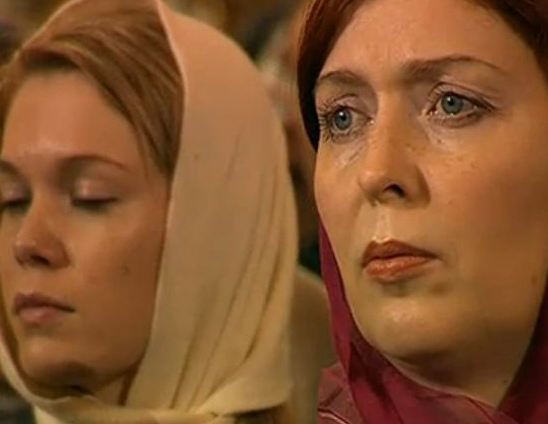
Now why would people want to do this kind of thing? We don’t know your motivations, Mr Whedon, but here are some images from the Divine Liturgy of Christmas in Moscow and Sochi from 2013. We think that the faces themselves explain why people would fear the Russian Orthodox Church and make them want to slander it.




Now why would people want to do this kind of thing? We don’t know your motivations, Mr Whedon, but here are some images from the Divine Liturgy of Christmas in Moscow and Sochi from 2013. We think that the faces themselves explain why people would fear the Russian Orthodox Church and make them want to slander it.
First here
are members of the congregation worshipping a few metres away from
President Putin at a monastery in Sochi:
Here is
President Putin himself:
Here is a
member of the choir:
Here is
Prime Minister of Russia Medvedev worshipping during the same Divine Liturgy of Christmas but at the Christ the
Saviour Cathedral in Moscow. He is with his wife. Presumably the
children are theirs.
Here are
members of the congregation at the same Divine Liturgy of Christmas at Christ the Saviour Cathedral:
Here is the
Patriarch of Moscow Kyrillos celebrating the same Divine Liturgy:
Orthodox
Monk


