Showing posts with label Social Commentary. Show all posts

Friday, 19 February 2016

Clarifying Remarks on a Post


Abcd Efgh” has posted a comment on “Love as a Spiritual Lens Through Which to View the Gospelwhich reads:
Why is a person who leaves the family, having been brought up badly, wrong? I don't get it, isn't it better for the person to leave? (signed Abcd Efgh)
Here is the passage that “Abcd Efgh” is commenting on:
Let us take another example. A young person has been brought up badly. They have left school and family and are living on their own. This is not an ideal Christian life. They have made an effort to resume their education but spiritually they are among lost ones. Perhaps, however, less lost than many still in school. They have spiritual interests. However, the first obstacle to their conversion is the notion of sin.
Will they find someone with love in their heart to guide them to Christ? For let us look at such a young person’s encounter with the notion of personal sin. A young person sins—in this day and age, who knows how? But they have spiritual interests. In some way God is calling to them, to their heart. God is calling them to Life. But the first thing they hear is, “Repent!” In the hands of the unloving preacher this is the road to an authoritarian judgmental Christianity; in the hands of the loving Elder or confessor, this is the beginning of a conversion to an Orthodoxy that is not formalist but a mystagogy of Life and Truth.
What “Abcd Efgh” thinks we mean is not what we mean. In saying that the person in question has left school and family and is living on their own and that this is not an ideal Christian life, we are not saying the person was wrong to leave. We are being descriptive. We do not know why the person left.
What we meant is that for a young person to leave school and family and live on their own is not ideal. It’s not the best situation for someone to be in. An analogy might make this clear. Someone has gangrene—let’s say they were caught in a blizzard and got frostbite. So the doctor cuts their leg off and gives them a motorized wheelchair. This is not an ideal personal situation. People should have two legs and walk around like everyone else.
Similarly in the ideal situation a young person needs their family, needs school. Circumstances may have been such that the person really had no choice but to leave—we are not judging—but the new situation is not ideal from a Christian or even from a psychological perspective. Indeed if you look at traditional cultures, not only is it the norm that the child stays with the parents until fairly old, but that child is even inserted within the extended family (grandparents, aunts, uncles and so on). Now sometimes this leads to intolerable situations—in Indian Hindu culture the bride goes to live with her husband who remains in the family home, where bride’s mother-in-law is often harsh with the bride—but it has to be recognized that although adolescence is a time of breaking away and establishing one’s own identity, it is also a time when the child needs emotional support, and in the case at hand, schooling to be able to take up a role in society. Moreover, as a practical matter for an adolescent to be living on their own is certainly opening them to sin.
Now as we pointed out, the person has spiritual interests and might even be in better shape than many still in school.
The person is where they are. God knows why they left and how intolerable the situation was. We don’t. But everyone on the face of the earth sometime has to turn to God. God meets us where we are.

Friday, 25 December 2015

Reply to a Comment


A reader has posted a comment on our post, Comments on the Vows of the Tonsure to the Great Schema. We tried to reply with a comment but for some reason it doesn’t work. Here’s our reply:
A married man can become a monk but by becoming a monk he dissolves the marriage in the eyes of the Church. However, the secular authorities would probably not recognize his action as dissolving the marriage. He would therefore at the least be liable for whatever actions and penalties under the secular law someone who had abandoned his wife and children would be liable to. However he himself would be bound to celibacy for the rest of his life.
In Greece in the 19th Century, the Government under the Bavarian King's Protestant advisors attacked Greek Orthodox monasticism forcing many monks and nuns to marry—but this was a persecution of the Church.
The only instance of married monks is in Japan where in the 19th Century, if we remember correctly, the Meiji Dynasty forced Buddhist monks to be married by law. This of course is a contradiction in terms for a Buddhist monk. There are even today married Buddhist monks, and even married Buddhist Abbots, in Japan. We have no information on how they live with their wives.

Wednesday, 11 September 2013

A Comment on our Post ‘A Charismatic Question by Email’

We have received a comment on our post ‘A Charismatic Question by Email’. We think that it is worth discussing this comment by ‘Commodus Firmus’ in a blog post. We have edited the comment for clarity.
Hi, the use of the name of Jesus is never in vain and what seems out of place and incompatible today might be a perfect fit tomorrow. If anyone wants to use the Jesus Prayer only good will come of it.
I grew up in Greece. On the one hand, I was steeped in Orthodoxy and the Jesus prayer from a very early age (I discovered the prayer when I was 8-10 and then when I was around 13 I tried it for the first time).
On the other hand, however, the institutionalized Orthodox Church of Greece (as a social structure) was so irrelevant and so unsuccessful in communicating its message that it was (and for many is) just repulsive. For years I was just one more ‘nominal Christian’. The Jesus prayer was the only indication that underneath the rather repulsive visible institutionalized ‘state religion’ there might be hiding a ‘pearl of great price’.
Then I met Protestants—some (nominally) still Greek ‘Orthodox’ but with evangelical tendencies—and also Pentecostals. In sharp contrast to the state church, these people looked as if they practiced what they preached and they taught me to read the Bible too. I was still trying the Jesus prayer every now and then, never ‘breaking’ its secret yet on every occasion I was left with the impression that there is a secret in this short repeated prayer. So I always returned to it. First every 2-3 years, then every 1-2 years, then even more often, until 30+ years after I discovered the Jesus Prayer it became a regular part of my life and returned my heart to the Orthodox Church. I still feel ashamed of the quality of leadership of the Orthodox Church—but then, am I any better? Yet every time some (over?)zealous Orthodox—seemingly out of petty antagonism—speaks ill of other denominations it pains my heart because I learned good things from them. Wasn’t it the Lord who said, ‘from their fruit you will know them’? Well, they are not perfect. It pains my heart too to see some of the doctrinal errors of the non-Orthodox, yet I see the good fruit as well and close my mouth.
The bottom line of all this: If some people want to practice the Jesus prayer, let them practice it—even help them to practice it—be they atheists, Buddhists or Protestants or whatever. The Name of Jesus has a power of its own to work unexpected wonders in the hearts of those praying, no matter who or what they are. Thank God no one has copyrighted the Jesus Prayer and no one has trademarked it! If fact I sometimes think that it works a ‘secret operation’ to bring people back to Orthodoxy. I don’t fear that the Jesus Prayer is something people can exploit commercially but see it more as a cornerstone that can be the foundation for the return [to Orthodoxy? to Jesus?] of those who will put their trust on it or a stumbling block that will crush those who will try to exploit it.
This comment is interesting for its clear expression of a person who although nominally Orthodox is a Protestant in spirit.

Thursday, 1 November 2012

Open Letter to Josh Whedon

Dear Mr Whedon:

At about the 11:30 mark in the film, Avengers, for which you are credited as director, screenplay writer and co-author, there begins a scene serving to introduce Natasha Romanoff, aka the Black Widow, played by Scarlett Johansson. The scene begins with a diesel train pulling into a rural train-station in Russia by night, then pans left to a ruined warehouse, where we find a scantily-clad Scarlett Johansson in distress, being tied to a chair and interrogated rather brutally in Russian by someone in a 3-star Russian general’s uniform. Then at about the 12:08 mark in the film, the camera cuts to a long shot where the interrogation continues in a mirror centered in the midst of a still life, thus:


We can see that the still life, which might be entitled ‘Still Life with Kalashnikov’, is a tastefully done still life with a 19th-Century type mirror artistically draped with an off-white fabric. Chicly arranged to the left of the mirror are two icons and on the right behind the two AK-47 assault-rifle barrels a picture that we couldn’t identify but which reminds us of the 16th-Century Dutch Masters (echo of Scarlett’s role as the girl with the pearl earring?).

We were rather curious about this composition. First of all, let us note that it adds nothing to the Avengers story-line. There is no further reference to icons—or indeed to Russia—in the Avengers. The only thing the scene can do is introduce Natasha, formerly Russian KGB agent and now agent of SHIELD. Nowhere further on in the film do we see Natasha’s dedication to icons or iconography, or even Natasha’s Russianness, since only in this scene does she speak Russian. So the question arises why the shot was included in the film. A case could be made that it is gratuitous. Moreover, the camera pulls back from the Still Life with Kalashnikov while at the same time keeping in focus the long shot in the mirror of Natasha being interrogated, so it’s a rather complex shot—unless of course it’s a digitally composited montage with the Natasha scene photographed separately and then digitally inserted into the space of the mirror. If the latter is the case, then the question arises even more strongly why the scene was included in the film: someone went to a lot of trouble to include Still Life with Kalashnikov in the film.

Let us look at the content of the Still Life with Kalashnikov.

First let us look at the icons. The main icon portrayed is a copy of this icon:


We say ‘copy’ because the original of ‘Our Lady of Perpetual Help’ is as follows:

Our Lady of Perpetual Help, also known as Our Lady of Perpetual Succour, is a title given to the Blessed Virgin Mary by Pope Pius IX, associated with a celebrated Byzantine icon of the same name dating from the 15th century.

The icon has been in Rome since 1499, and is currently in the church of Sant'Alfonso di Liguori all'Esquilino. In the Eastern Orthodox Church this iconography is known as the Virgin of the Passion or Theotokos of the Passion.

Due to the Redemptorist Priests who had been appointed as missionaries of this icon, the image has become very popular among Roman Catholics in particular, and has been very much copied and reproduced. Modern reproductions are sometimes displayed in homes, business establishments, and public transportation. The Redemptorist priests are the only religious order currently entrusted by the Holy See to protect and propagate a Marian religious work of art.

The icon has merited two Papal endorsements, one from Pope Pius IX who entrusted the icon to the Redemptorist in December 1865, and another from Blessed Pope John Paul II, who presented an icon to a Muslim cleric in May 2001 during his first-ever visit to the Umayyad Mosque.

A feast in honour of the icon was celebrated on 27 June and “novena” prayers are customarily held on Wednesdays. Today, the feast day of the Our Lady of Perpetual Help is celebrated on June 27 of the year, with novenas held every Wednesday of the weeks of the year.

(From Wikipedia, which is probably where we got the image of the icon. For a more strictly Roman Catholic discussion see the Catholic Encyclopedia)

So the icon has nothing to do with Russia. (Pope John-Paul II was Polish and Russians and Poles are almost the same, we know, but still it’s not a Russian icon.) Moreover, unless someone was going to steal the icon from its heavily guarded place in Rome, it’s not something that a Russian arms smuggler would have in his dilapidated warehouse in the Russian boondocks.

The icon above and behind Our Lady of Perpetual Help (still to the left of the mirror) is more difficult to identify. We at first thought the icon might be of St Nicholas, the patron saint of Russia (although we doubt he is the patron saint of Russian arms dealers), but study indicates the following. The icon is of a full-bearded male saint holding a very large Gospel book. The saint is depicted in roughly ¾ profile from his left side. The framing of the icon—a sort of clover leaf inside a square—reminds us of the icons of the Evangelists that are normally found on the Royal Doors of the iconostasis in every Orthodox Church, as do the small sub-icon above and to the right of the saint’s head—it could very well be the scriptural symbol of the Evangelist—and the ¾ profile.

The Royal Doors are the main entrance to the sanctuary; they are in front of the Holy Table (what Westerners would call the altar, though in the Orthodox Church the whole area behind the iconostasis is called the altar).

Normally the Royal Doors has two iconographical programs: the Annunciation of the Birth of Christ to the Mother of God by the Archangel Gabriel and, separately, the Four Evangelists. We were not able to find the particular icon portrayed in the Avengers and hence the Royal Doors from which it might have been taken, but the following should give an idea of what’s involved:


Above we see the Annunciation and below we see the Four Evangelists. St John the Evangelist is in the lower right corner; we can see that the portrayal of St John here is consistent, mutatis mutandis, with the icon in the Avengers, although here the iconography is undistinguished. The icongraphical portrayal of an Evangelist is fixed and it is relatively easy to identify an Evangelist if he is portrayed according to classical prototypes even if the name of the Evangelist on the icon is unclear. 

Here is a set of Royal Doors which while missing the Annunciation shows clearly where the Royal Doors are in an Orthodox church: the Holy Table can be discerned behind the Royal Doors. In this case St John the Evangelist is in the upper right corner.


Here is a clearer icon of St John the Evangelist, the composition of which might parallel the icon in the Avengers under discussion:


Our judgement is that most likely the icon above Our Lady of Perpetual Help in Still Life with Kalashnikov is taken from a 19th-Century Royal Doors, perhaps of Russian origin. Moreover we are of the opinion that the Evangelist portrayed is St John.  Chances are that the icon was borrowed from a gallery for the shoot.

However, here is the Royal Doors from the Cathedral of Christ the Saviour in Moscow during the 2013 Christmas Divine Liturgy. We can see the Annunciation above and the Four Evangelists in two groups of two below. The 19th-Century iconographical program here is more Renaissance than in the icon under discussion, which would suggest that the icon of the Evangelist from Still Life with Kalashnikov dates from an earlier period.


Presumably the evil-doers who are interrogating Natasha do one of the following:
  • They pray before the Roman Catholic icon of Our Lady of Perpetual Help when they’re not torturing the scantily-clad Scarlett Johansson;
  • They smuggle icons when they’re not smuggling Kalashnikovs;
  • They smuggle icons at the same time they’re smuggling Kalashnikovs (‘Get your free authentic Russian Orthodox Roman Catholic icon with any black market purchase of 1000 Kalashnikov rifles, offer valid while supply lasts’). Today, however, the usual black market for the Kalashnikov is the Muslim jihadi and Muslim jihadis would not be interested in icons. However, perhaps the smugglers are imitating Pope John-Paul II, above;
  • Their business model includes a church supply business; or
  • All of the above.
We couldn’t come up with anything on the picture to the right of the mirror, although it did remind us of the Dutch Masters, as we have said. Vermeer comes to mind although the picture does not appear in his catalog. The Lacemaker is similar in composition but it is not the same.

We are sure you will agree, Mr Whedon, that it would only be right to give those of our pious Orthodox readers who feel that they have a religious vocation that includes arms smuggling a brief summary of the range of Kalashnikov assault rifles available on the market for smuggling.


Of course, one can see that the Kalashnikov included in the Still Life with Kalashnikov is the classic AK-47:


We should point out that as the camera pulls back from Still Life with Kalashnikov, there are a number of what look like RPG rounds below the icon of Our Lady of Perpetual Help (not shown).

Moreover, it should also be pointed out that in terms of the rest of the scene, the phone-call to Natasha is incoherent: the speaker warns the General of an imminent F-22 attack on the place but describes the place completely differently from what we see and as being in a completely different location.

So the question arises, Mr Whedon, what it’s all about. What’s this stuff doing in the Avengers?

Now let us continue with the iconographical program of the Avengers. We’ve just dealt with the evil ones of the Avengers. Now here’s a superhero from the Avengers, Iron Man without his iron as portrayed by Robert Downey:


To be a little clearer about Iron Man’s casual-wear sartorial program, here’s his t-shirt in more detail:


As we can see it’s a t-shirt for Black Sabbath, the occultist rock group. So we have a strong contrast: in the Avengers the evil ones are gratuitously juxtaposed with Christian icons but the superhero is gratuitously identified with an occultist rock group. Hmm....

While we would be surprised to learn that you have an overt hostility to Russian Orthodoxy, Mr Whedon, you know as well as we do that this is how propaganda works. Sophisticated information operations juxtapose images that the perpetrators want the viewer to associate with evil with obviously evil persons, and they juxtapose images that they want the viewer to associate with good with obviously good persons. Here we see Christian icons gratuitously juxtaposed with obviously evil men; and an occult icon (Black Sabbath) gratuitously associated with obviously good men. The effect is, as they say, long-term and subliminal.

Let us look a little more at the context of this.

Here’s the casual-wear sartorial program of the evil Russian General:


There’s a flash on his left arm that shows the Russian flag and which reads ‘Russia’ in Cyrillic:


You can also see his three stars, so he’s a 3-star evil Russian General. The only thing missing in the Avengers portrayal of the 3-star evil Russian General is the open bottle of vodka. Must be your light directorial hand, Mr Whedon.

However, we can see this in the uniform of a genuine 3-star Russian General:


No Russian flag on the flash on his left arm. And this guy’s the real deal. He’s Russian Deputy Chief of General Staff Col-Gen Anatoly Nogovitsyn. Far more clean cut guy. 

Here Nogovitsyn’s boss, 4-star General Makarov, Russian Chief of General Staff:


Scary looking guy. Wouldn’t want to shoot a nuclear missile at his town.

Here’s an American 4-star General, General George C Marshall:


Wouldn’t want to shoot a nuclear missile at him either.

Here’s the guy who invented the Kalashnikov. He’s being presented with a medal by then-President Medvedev. His name, strangely, is Kalashnikov. He’s 90 years old. He’s only a 2-star general.


So why are we wasting our time on this, Mr Whedon? Here in its entirety is a recent article from the Independent, a London newspaper. We would ask you to read the article through to its conclusion despite the unseemly subject matter.

Get thee to a monastery... there's a brothel there

Roland Oliphant
Wednesday, 31 October 2012
The Russian Orthodox Church is furiously trying to calm a media storm after police uncovered a brothel on the grounds of one of Moscow's most prestigious monasteries.
The "hotel for lovers" was found operating out of a building belonging to the Sretensky Monastery, an ancient institution just up the road from the headquarters of the Federal Security Service. Two women, from Ukraine and Tajikistan, were arrested during a raid at the weekend.

The institution's seedy reputation was apparently well known. Local media reported that it rented out its seven rooms by the hour, at rates starting from 1,750 roubles (£35).

Founded in 1395, the monastery is one of the city's oldest religious institutions. Legend has it that it was founded on the spot where Muscovites met a miraculous icon of the Virgin Mary brought from the neighbouring city of Vladimir to save Moscow from Tamerlane's marauding armies.

The monastery's Father Superior, Archimandrite Tikhon, is said to be President Vladimir Putin's personal spiritual adviser. Father Tikhon hit back at what he called a "media sensation" surrounding the brothel, telling a state-owned channel that the "lovers' hotel" was in a building the monastery acquired only recently, and that evicting the current business occupying the premises was one of the conditions of the sale. He even joked that the church was "lucky" the issue had finally been dealt with.

"Today's storm in the media is just one example of how people are willing to take any slander and not only make a vulgar joke out of it, but launch a very real information attack against the Church," he said.

Here we see another propaganda technique. The article, in a newspaper owned by a wealthy Russian emigre who is said to be a political opponent of Putin, starts off with the strong suggestion that a Russian Orthodox monastery is running a brothel. Only in the second-to-last paragraph do we learn that ‘the “lovers' hotel” … [is] in a building the monastery acquired only recently, and that evicting the current business occupying the premises was one of the conditions of the sale.’

The journalist, assuming that he is not just plain incompetent, seems to be banking on the fact that, as is well-known, most people read only the first few lines of a newspaper article, taking the gist from that. So most people would not read through to the ‘fine print’ at the end of the article that negates the first few lines implying that the Russian Orthodox Church is running a brothel in Moscow. Moreover, because the journalist has told the truth in the fine print at the end of the article he can’t be accused of lying—he’s told the truth even if he’s counting on no one reading it.

The article notes that the monastery is located close to the Russian security services. Since the monastery was founded in 1395, it’s no fault of the monks that they are located close to the security services. They’ve been there for 600 years. Again we juxtapose what we want people to think is bad (the Russian Orthodox monastery) with something people know is bad (the Russian security services).

What bothers us is the sense that there is a cultural war on Christianity. A cultural war on Orthodoxy. A cultural war on Russian Orthodoxy. We think that Archimandrite Tikhon is onto something:

Today's storm in the media is just one example of how people are willing to take any slander and not only make a vulgar joke out of it, but launch a very real information attack against the Church.

So we want to pose this question to you, Mr Whedon:  You are a wealthy man. Are you a good man?

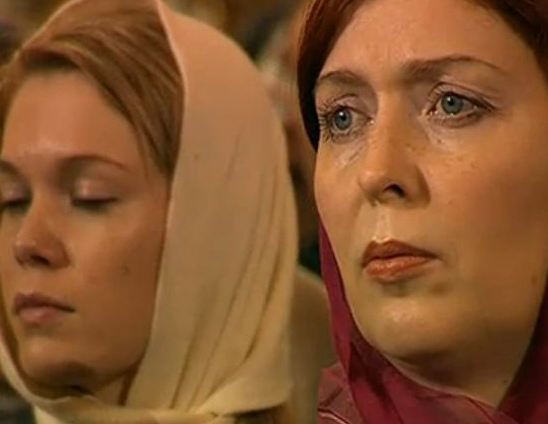
Now why would people want to do this kind of thing? We don’t know your motivations, Mr Whedon, but here are some images from the Divine Liturgy of Christmas in Moscow and Sochi from 2013. We think that the faces themselves explain why people would fear the Russian Orthodox Church and make them want to slander it.

First here are members of the congregation worshipping a few metres away from President Putin at a monastery in Sochi:


Here is President Putin himself:


Here is a member of the choir:


Here is Prime Minister of Russia Medvedev worshipping during the same Divine Liturgy of Christmas but at the Christ the Saviour Cathedral in Moscow. He is with his wife. Presumably the children are theirs.


Here are members of the congregation at the same Divine Liturgy of Christmas at Christ the Saviour Cathedral:


Here is the Patriarch of Moscow Kyrillos celebrating the same Divine Liturgy:


Orthodox Monk

Thursday, 13 September 2012

Back Beat 2


After reading our post Back Beat on Orthodoxy and Classical Music, the person who originally submitted the comment discussed wrote to us to ask us further about the matter of classical music and Orthodoxy. The person is a classical musician who is contemplating converting from Lutheranism to Orthodoxy. We hope there are any number of such persons so that we are not giving anything away about this person’s identity.

First of all, our interlocutor, let us call her Alice, originally made her comment under a pseudonym. She later apologized to us for that. We didn’t think an apology necessary. The Internet is a dangerous place and it behoves all of us to be careful. A pseudonym is perfectly in order on the Internet. So Alice it is. And let us say that Alice lives in Manhattan, which most assuredly is not her real residence.

Alice is quite worried that Orthodoxy might not accept classical music, which she loves. First, let us be plain: no one is going to tell anyone that they have to stop being a classical musician to enter the Orthodox Church. That’s just not going to happen. There are, we suppose, some professions that are incompatible with Orthodoxy. We don’t think classical musician is one of them. We suppose that being a rock musician specializing in dark, Gothic music might be incompatible with Orthodoxy but that is not what Alice is asking about. She isn’t a dark, Gothic musician; she is a professional classical musician.

So Alice can join the Orthodox Church and continue her profession.

However, what is the issue about classical music? Well, actually there isn’t one. The Orthodox Church doesn’t have a dogmatic position on classical music. It’s not in the stuff you have to believe to become Orthodox. So why then would dark, demonic music be forbidden?

Because it’s dark and demonic. We suppose that if there were a branch of classical music that could be construed to be dark and demonic then a sensitive confessor would persuade Alice to stop playing and listening to it. Is there such a dark and demonic classical music? We frankly don’t know. Wagner springs to mind; we mentioned in Back Beat that Satie was a Rosicrucian. But this is not something as obvious as your local stoned-out Satan-worshipping heavy-metal rock band.

Let’s look at some classical composers. First, Bach. Bach was an intensely devout Lutheran. No one can listen to his religious music without grasping that he believed. Now consider Rachmaninoff. It’s not entirely clear whether Rachmaninoff was ever properly inserted into the Orthodox Church. He was baptized; he was Orthodox; he didn’t seem to practise his Orthodoxy and in some cases seemed to be living a sinful life. We’re not in the Rachmaninoff-judgement business but a question could be raised whether he was a candidate for sainthood. However, his Orthodox liturgical music can be quite pleasant to listen to. However, and this is important, it is ultimately sentimental. But then ultimately so is Bach sentimental.

We suppose a musicologist would discuss the differences—apart from differences of genre—as between Bach and Rachmaninoff. He or she might want to argue that Bach is musically deeper than Rachmaninoff. We would tend to agree even though we think that both composers are working with the sentiments. But Bach was Lutheran and Rachmaninoff was Orthodox. As we can see, things get very complicated.

There are all kinds of genres in Western classical music and composers composing in those genres of all different beliefs and states of virtue. This is also true of performers of Western classical music. There is no possible way to categorize all of Western classical music—or even its performers—according to Orthodox spiritual standards.

So what, really, is the issue that Elder Paisios was raising that we referred to in the previous post?

Well, first of all, Elder Paisios is in Heaven and we will have to wait to ask him for clarification. We don’t know precisely what he meant. He was speaking to a specific person in a specific place. He was speaking for that person in that place. His words might not apply as a rule of Orthodox faith in a general setting—and certainly Orthodox dogma can never be defined by the words of one Elder only.

However, what we think Elder Paisios meant—and we could be wrong—is this. Elder Paisios was speaking to a member of the Orthodox Church about the personal effect that music has on a person. What he was saying is that ultimately Western classical music remains on a human, sentimental plane. Rock music remains on a demonic plane. Only Byzantine chant has a spiritual effect on a person.

Our friend George has spent more time on Mt Athos than we have. He told us of once attending the patronal festival of St Panteleimon at the Russian Monastery of St Panteleimon on Mt Athos. This would be about 50 years after the death of St Silouan (+1938), who himself was a monk of St Panteleimon’s. The patronal festival that George attended at St Panteleimon’s was an all-night vigil. George remarked that in the canons of Orthros the Russian cantors alternated with the Greek cantors. First the Russians would sing a hymn from the service book, then the Greeks would sing the next one. The Russian cantors were among the best Russian cantors of Athos and Russia whereas the Greek cantors were among the best cantors of the Greek monasteries of Athos. The Russians chanted in the Westernized chant in vogue among Russians whereas the Greeks chanted in the classical Byzantine chant of Athos. George said that when the Russians chanted he felt greatly moved emotionally and tears came to his eyes but when the Greeks chanted he felt great spiritual sobriety. “It was weird,” he said to us, “One moment the Russians would be chanting their hymn from the service book and my eyes would be full of tears and the next moment the Greeks would be chanting the next hymn from the same service book and I’d be soberly saying the Jesus Prayer in something straight out of the Philokalia. Then the Greeks would finish and the Russians would start the next hymn and I would go back to crying.”

That, we think, is what Elder Paisios was driving at. Byzantine chant supports the classical spiritual sobriety that is taught in the Orthodox Philokalic tradition. Russian Westernized chant—and this by extension would include Western religious music—works more on the emotions, creating effects on the sentiments, so that the person is sentimentally moved to religious emotions. This is better than demonic emotions, certainly, but it is not the same as the spiritual sobriety of the Philokalic tradition. This is very difficult for a Westerner to comprehend, we know, because Westerners have been taught all their life that the only possibility is for religious emotion. There’s no provision in their Western upbringing and education for the Philokalic spiritual sobriety that is compatible with Byzantine chant and which is supported by Byzantine chant.

What is behind all of this is the notion that music has an effect on the person hearing it. It can agitate, calm, make sad, make happy—or even support Byzantine Orthodox spiritual life.

But the Russians are no slouches when it comes to philokalic spirituality. After all, Way of the Pilgrim, that famous introduction to the Philokalia, was found in a manuscript at St Panteleimon’s Monastery on Athos. Moreover, St Panteleimon’s Monastery is where St Silouan lived, also Staretz Sophrony. Certainly, in Russia proper St Seraphim of Sarov was a practitioner of the Jesus Prayer who no one would want to suggest was a second-class saint. The 19th- and early-20th-Century saints of Optina are renowned for their command of philokalic spirituality. So while Russian liturgical music may be a bit more sentimental than Byzantine liturgical music, that doesn’t mean you can’t become a saint in either tradition. There is ample evidence to the contrary.

We can see the same distinction between the sober and the sentimental in Byzantine and Western religious art. The two arts were pretty much the same until a certain period, when Western religious art began to diverge from the received iconographical tradition.  This is not prejudice on our part; any art historian can explain that up to a point the two traditions were the same and that after about the 11th Century Byzantine iconography remained much closer to that common tradition than Western religious art.

Here is the 6th Century Church of San Vitale, Ravenna, Italy, the apse:

 
The acme of Western religious art in its divergence from the common tradition is probably the High Renaissance, in the works of Michelangelo. This is already a sentimental art but at least it’s well done.

 Here is Michelangelo's Risen Christ (Christ Carrying the Cross, 16th Century):


The naturalism of Michelangelo is quite evident in this sculpture; the point that Elder Paisios was making, we think, is that such a naturalistic art remains on a human plane affecting only the human emotions whereas Byzantine art raises the mind to the spiritual.
 
For reference here is Christ, detail from the 13th Century Deesis Mosaic in St Sophia:


We would have preferred to stay in a single medium (painting or mosaic) but it's not easy to find images for upload on short notice, hence the use of a sculpture by Michelangelo rather than a painting.

To make the point clearer, here is the Madonna and Child by Raphael (16th Century):


For reference, here is the 12th Century Our Lady of Vladimir icon, painted in Constantinople:


No one doubts Raphael's ability but his art is quite naturalistic and as such it works on the emotions.  It would be useful for the viewer to obtain a good copy of the Our Lady of Vladimir icon to study the facial expression on the Theotokos; this icon is an example of the icon as door to the spiritual, something that is completely missing in Raphael's painting.

After that it’s downhill.

Of course Byzantine iconography has had its vicissitudes; who doesn’t love the sentimental, Westernized kitsch of the 20th Century?


And Russian iconography is not all Rublev’s Trinity:


But classical Byzantine iconography has always maintained an ideal of the spiritually sober.

Let us now look at the issue from the point of view of Alice’s conversion to Orthodoxy. Alice is somewhere: she’s of a certain age, of a certain cultural, familial and ecclesiastical background. She has grown interested in Orthodoxy. She has a number of options open to her if she decides to join the Orthodox Church. She could join a Russian jurisdiction or she could join a more Greek-Byzantine jurisdiction. Wherever she goes she will find that she is on earth, not yet in Heaven—that there are problems. But that aside, from the point of view of music she could certainly join a jurisdiction that used a more Westernized liturgical music, something more similar to what she herself deals with in her profession. Given her training, she might like that Westernized liturgical music or she might hate it—she will obviously have a highly developed taste and that taste might agree with the music of the jurisdiction or it might disagree with it violently. It’s something she will have to consider.

But that is not the crux of the problem: Alice is not joining a musical club; she’s working on her salvation. She should be joining the Orthodox Church, if she joins, because she thinks that it brings her salvation and knowledge of the One True God. So what if the music is or is not a little kitschy (if it is)?

What we think happens is this. Alice joins the Orthodox Church and commences an Orthodox spiritual life. We strongly recommend reception by Baptism. That is a complete transformation to make a new creation. After Baptism, Alice doesn’t realize how transformed she is; others begin to see the difference but Alice doesn’t until after a year or so. However, be that as it may Alice continues her profession. The same scales every day for 2 hours; the same studies for 3 hours; the same concert pieces for 5 hours. The same routine at the orchestra, the same students for lessons. Nothing’s changed. Alice has a stereo set and plays classical music and also experiments with listening to the liturgical music of her new religious environment. Maybe Alice joins the Church choir—even though Alice is a classical musician that doesn’t mean she has the ability, time or inclination to sing in the choir; it’s not obligatory in any case.

In any event, Alice’s musical taste slowly starts to change. Why? Because Alice has slowly started to change. If she weren’t going to change, and didn’t want to change, why would she join a new religion?

So Alice changes as a person. She matures—spiritually, psychologically and so on. Why wouldn’t her taste in clothes, furniture and everything else also change? Including her taste in music, where she has a highly developed artistic sensibility? She starts to hear pieces that she liked as being of poor quality. She starts to hear pieces that she didn’t care for with new ears, seeing a new depth that she hadn’t realized was there. But some things that Alice liked she still likes, and some things she hated she still hates. Alice is alive. She’s still Alice from Manhattan.

Let us suppose that Alice plays 1st Violin at the New York Philharmonic. She goes to rehearsals; she plays the 1st Violin part of whatever has been selected, doing the best she can; in concerts she performs in her black dress doing the best she can. And as Alice grows after becoming Orthodox so does her appreciation of the music she is playing professionally.

Will Alice become a better musician once she becomes Orthodox? If Alice makes a serious effort at repentance and prayer and spiritual growth she will become a better person. Surely being a better person would make Alice better at whatever she set her hand to, including her profession. It is conceivable, indeed, that God might grant a spiritual charism to assist Alice musically but this is something that God knows, not Alice, before she becomes Orthodox. And what is important is that Alice became Orthodox to grow spiritually, not to improve her professional competence in an orchestra.

Now someone asks Alice to play violin in a local rock band. Alice, who’s Orthodox now, devoutly attending church and receiving communion, graciously declines, saying she has no time.

Next, someone asks Alice to be the conductor of a church choir in a non-Orthodox church (let’s suppose she has the ability). Does Alice accept? We wouldn’t, but this is something for Alice to discuss with her confessor.

What happens if the New York Philharmonic starts playing many, many pieces by composers known to be non-Orthodox, non-Christian, anti-Orthodox and anti-Christian? This gets complicated and Alice needs to consider her priorities.

Finally, we would recommend that Alice, if she has the time, begin a study of Byzantine music, its scales, notation, performance, compositions, history. This is not obligatory and Alice might not even like Byzantine chant. But it seems obvious that this will be a big part of Alice’s new religion and that Alice would want to learn something about it at a level consistent with her training. One thing we do know is that the Byzantine scales do not have the same intervals as Western scales and it is very difficult for a Western-trained singer to ‘convert’ to Byzantine chant, and vice versa. This is a matter of human physiology. The organs of voice production have been trained in one way; the other type of music requires a completely different training of the voice-production organs, making it impossible to switch from the one music to the other. We imagine the same is true for an instrumental musician in terms of how the ear hears the scales. Assuming Alice plays the violin, it wouldn’t be that easy for Alice to convert to playing Byzantine scales on the violin, although we are sure that she could demonstrate Byzantine scales on a one-off basis.

We hope that helps, Alice.